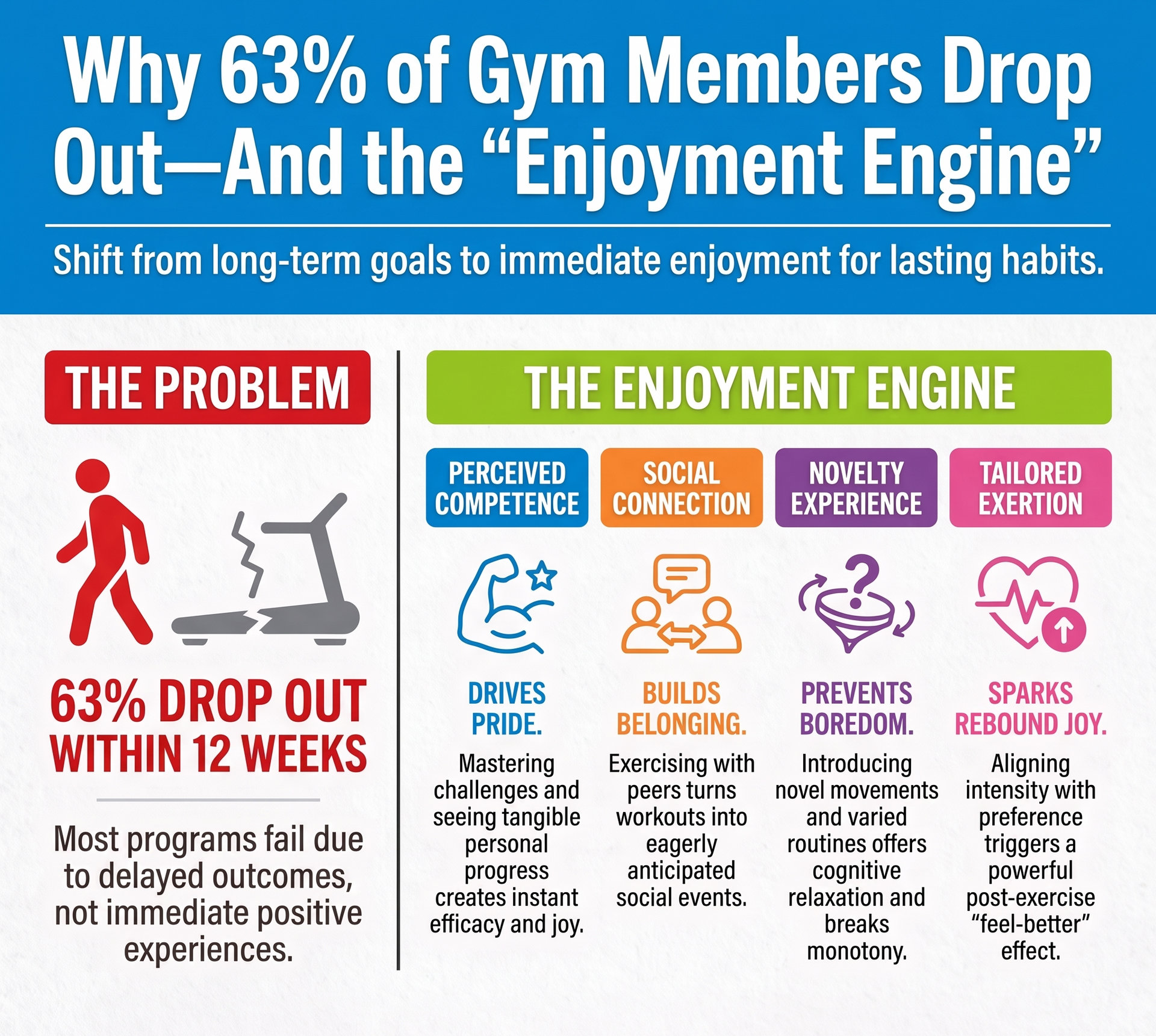
The commercial fitness industry operates under a costly business paradox. Facilities invest heavily in cutting-edge resistance machines, luxury locker rooms, and high-decibel marketing campaigns to pull new members through the front door, only to watch them quietly exit through the back. In typical fitness facilities, attrition curves drop off precipitously, with up to half of new members abandoning their workout routines within the first few months.
For gym owners and facility operators, this constant turnover creates severe operational friction, unpredictable cash flow, and escalating customer acquisition costs. Traditional retention strategies often rely on long-term binding contracts or equipment upgrades. However, rigorous empirical research reveals that equipment and facility features do not drive long-term workout consistency. Building a resilient, high-retention facility—an "unshakeable gym"—requires shifting focus from passive facility management to active community design, service convenience, and social capital.
The Satisfaction Trap: Why Clean Facilities Do Not Guarantee Active Members
Many gym executives assume that high customer satisfaction with facility features naturally yields high member retention.
Empirical research shows this assumption is flawed. In a one-year prospective study conducted in Norway tracking novice exercisers across 12 months, researchers examined the relationship between customer satisfaction and actual workout attendance.
The findings exposed a massive disconnect between paid membership and actual physical engagement:
- The Attendance Drop-Off: While 51.8% of new members managed regular exercise attendance (defined as an average of at least two sessions per week) at three months, that figure plummeted to 37.6% at six months and 37.4% at 12 months.
- The Consistency Deficit: Only 17% of members maintained regular attendance consistently across all three evaluation periods throughout the year.
- The Contract Illusion: At the 12-month mark, 86.6% of participants were still paying gym members, largely because they had purchased non-cancelable 12-month contracts.
Crucially, the study revealed that customer satisfaction ratings regarding gym facilities, equipment quality, service atmosphere, group class schedules, or personal trainers showed no significant statistical correlation with regular workout attendance.
Members can be entirely satisfied with a gym's cleanliness and opening hours while simultaneously failing to show up.
Binding contracts may protect short-term subscription revenue, but they fail to build habituated exercisers who renew voluntarily year after year.
The Enjoyment Engine: The Real Predictors of Exercise Adherence
If clean locker rooms and top-tier cardio machines do not keep members coming back, what does? The Norwegian longitudinal study used mixed-effects logistic regression modeling to isolate the specific psychosocial motives that reliably predict long-term workout attendance among novice gym members.
The analysis identified three primary factors that significantly increase the odds of maintaining regular attendance:
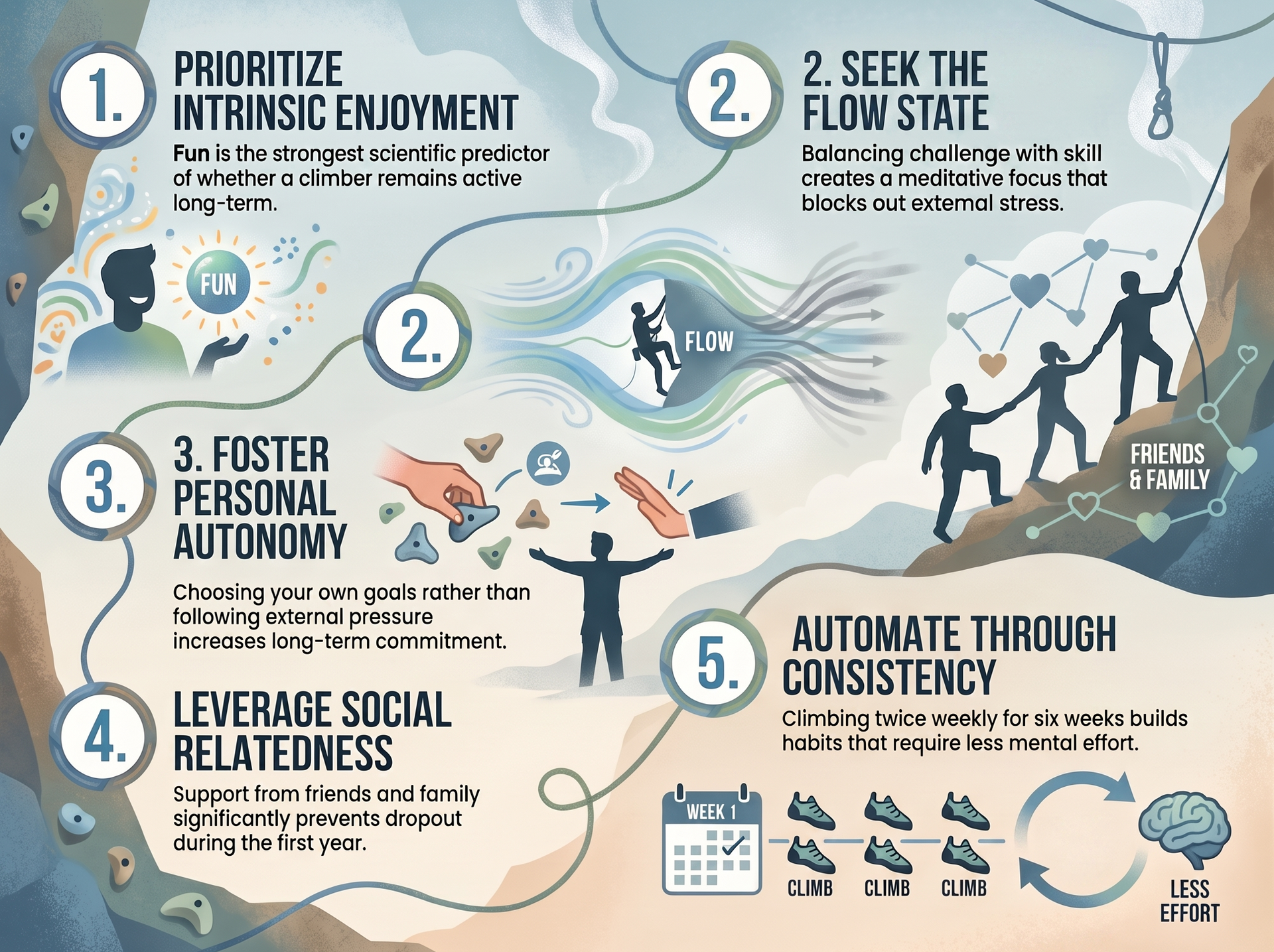
- Intrinsic Enjoyment: Experiencing inherent pleasure and satisfaction during exercise was the single strongest predictor of regular attendance, increasing the likelihood of long-term adherence by 84%.
- Self-Efficacy ("Sticking to It"): A member's confidence in their personal ability to maintain a workout routine despite routine obstacles increased adherence likelihood by 73%.
- Social Support: Encouragement from external social networks, including family and friends, significantly boosted the odds of regular gym attendance.
When members view exercise as a grueling chore performed solely for extrinsic physical goals, workout adherence remains fragile.
Conversely, when facilities design experiences that foster immediate affective enjoyment, personal mastery, and social reinforcement, exercise shifts from a forced decision to a sustained habit.
Social Capital and Belonging: Lessons from Community-Driven Gym Models
To build intrinsic enjoyment and social reinforcement into the physical facility, operators must examine how gym architecture and programming shape human interaction.
A study conducted in the United Kingdom directly compared the psychological dynamics of a traditional gym with a community-focused CrossFit gym model.
In traditional fitness centers, members frequently create virtual boundaries, exercising individually while wearing headphones in a room full of strangers. In contrast, group-based models incorporate structured cohort onboarding (such as "on-ramp" beginner courses), standardized group programming, shared language, and collective achievements.
The empirical data from the United Kingdom study demonstrated striking differences between the two environments:
- Total Social Capital: CrossFit members reported significantly higher total social capital scores compared to traditional gym members.
- Bridging Social Capital: CrossFit members scored substantially higher in bridging social capital—the ability to establish broad, diverse social connections.
- Bonding Social Capital: CrossFit members reported stronger bonding social capital, representing close, supportive friendships within the facility.
- Community Belongingness: General feelings of inclusion and community belonging were significantly elevated among CrossFit members compared to traditional gym members.
Both social capital and community belongingness positively correlated with weekly gym attendance across the total sample.
However, the study also provided a critical nuance for facility managers: in linear regression modeling, social capital, community belongingness, and gym type combined accounted for only 6% of the overall variance in weekly gym attendance, and none proved to be an independent significant predictor.
Social capital and community belonging are powerful catalysts for member satisfaction, but they cannot carry a facility's retention strategy in isolation—they must be integrated into a seamless operational system.
The Value Architecture: Linking Service Convenience to Behavioral Loyalty
How do operators connect social community and facility operations into a cohesive system that drives revenue?
A study of 326 fitness center members conducted in Turkey provides the quantitative blueprint using structural equation modeling.
The researchers evaluated the chain of impact starting from
service convenience—defined as minimizing the non-monetary time and effort required to access and complete a workout. Service convenience includes factors such as seamless parking, fast check-in, efficient equipment access, and friction-free scheduling.
The structural model mapped out how service convenience flows through four distinct dimensions of perceived member value to drive ultimate behavioral loyalty:
- Service Convenience Powers Perceived Value: High service convenience exerted a massive direct positive effect across all four value dimensions:
social value,
functional value,
emotional value, and
economic value.
- Economic and Functional Value Drive Satisfaction: When testing which value dimensions directly convert into customer satisfaction,
economic value demonstrated the strongest predictive power, followed by
functional value. In this direct structural path, social value and emotional value did not reach statistical significance for overall customer satisfaction.
- Satisfaction Secures Repeat Intentions: Customer satisfaction strongly and directly determined future behavioral intentions, including subscription renewal and positive word-of-mouth recommendations.
These findings deliver an essential operational lesson for gym managers: while social capital enriches the member experience, member satisfaction and long-term behavioral loyalty depend heavily on perceived economic return and functional utility.
Members evaluate whether the physical and health gains they achieve are worth the monthly price and non-monetary time spent. Removing operational friction elevates every dimension of perceived value.
Operational Blueprint: Building the Unshakeable Gym
To transform these empirical insights into higher member retention, gym operators, fitness directors, and facility managers should implement a four-part operational strategy:
- Eliminate Friction to Maximize Service Convenience: Audit every step of the member journey. Streamline locker room access, optimize peak-hour floor traffic, maintain equipment impeccably, and offer flexible class scheduling. Reducing the non-monetary costs of time and effort elevates perceived functional and economic value.
- Engineer Cohort Onboarding: Move away from unsupervised, unstructured gym intros. Implement mandatory or incentivized beginner onboarding cohorts that group new members together. Fostering shared identity and early interaction builds bridging and bonding social capital from day one.
- Design Workouts for Immediate Affective Enjoyment: Train fitness instructors and staff to coach for personal mastery, positive affective experience, and self-efficacy, rather than pushing beginners to painful exhaustion. Workouts that cultivate intrinsic enjoyment and competence keep members returning long after initial motivation fades.
- Activate External Social Networks: Recognize that social support outside the gym directly fuels attendance inside the gym. Create partner membership packages, referral challenges, and family-inclusive events that tap into members' existing social support systems.
By shifting focus from passive equipment hosting to active community architecture and seamless service convenience, facility operators can break the cycle of attrition and build a profitable, high-retention fitness business.