The indoor climbing industry is experiencing a profound shift. Commercial climbing facilities are opening across the globe, scaling from niche enthusiast hangouts into mainstream commercial fitness hubs. Yet, beneath the surge of foot traffic and introductory belay class sign-ups lies a quiet operational bottleneck that directly impacts gym profitability:
first-year member churn.
Industry benchmark data reveals a stark contrast between standard commercial fitness clubs and indoor climbing facilities. While traditional fitness centers average an annual retention rate of roughly
60% to 65%(see
also), data from the Climbing Wall Association (CWA) shows that the average 1-year member retention rate for climbing facilities
hovers around 39.6%. This means that over
60% of new climbing gym members cancel their memberships within their first 12 months.
For gym owners, founders, and operations directors, this high turnover creates an expensive acquisition burden.
Studies in service marketing
confirm that acquiring a new customer costs between five to nine times more in marketing, onboarding, and administrative overhead than retaining an existing one. To build sustainable, recurring revenue, gym operators must look beyond pure acquisition and
address the root causes of early drop-off.
The Root Causes: Why Intermediate Climbers Quit in the First 90 Days
Behavioral research and service sector retention models demonstrate that customer retention relies heavily on
customer satisfaction, which drops rapidly
when a consumer experiences a gap between their expectations and actual progression. In commercial climbing gyms, this expectation-reality gap manifests around the 90-day mark due to four distinct, systemic hurdles:
1. The Skill and Biomechanical "Plateau"
Beginner climbers experience rapid initial gains on easy terrain (VB–V2 or 5.6–5.9) by relying heavily on brute upper-body strength. However, as wall angles steepen and hold orientations shift toward slopers, volumes, and small edges,
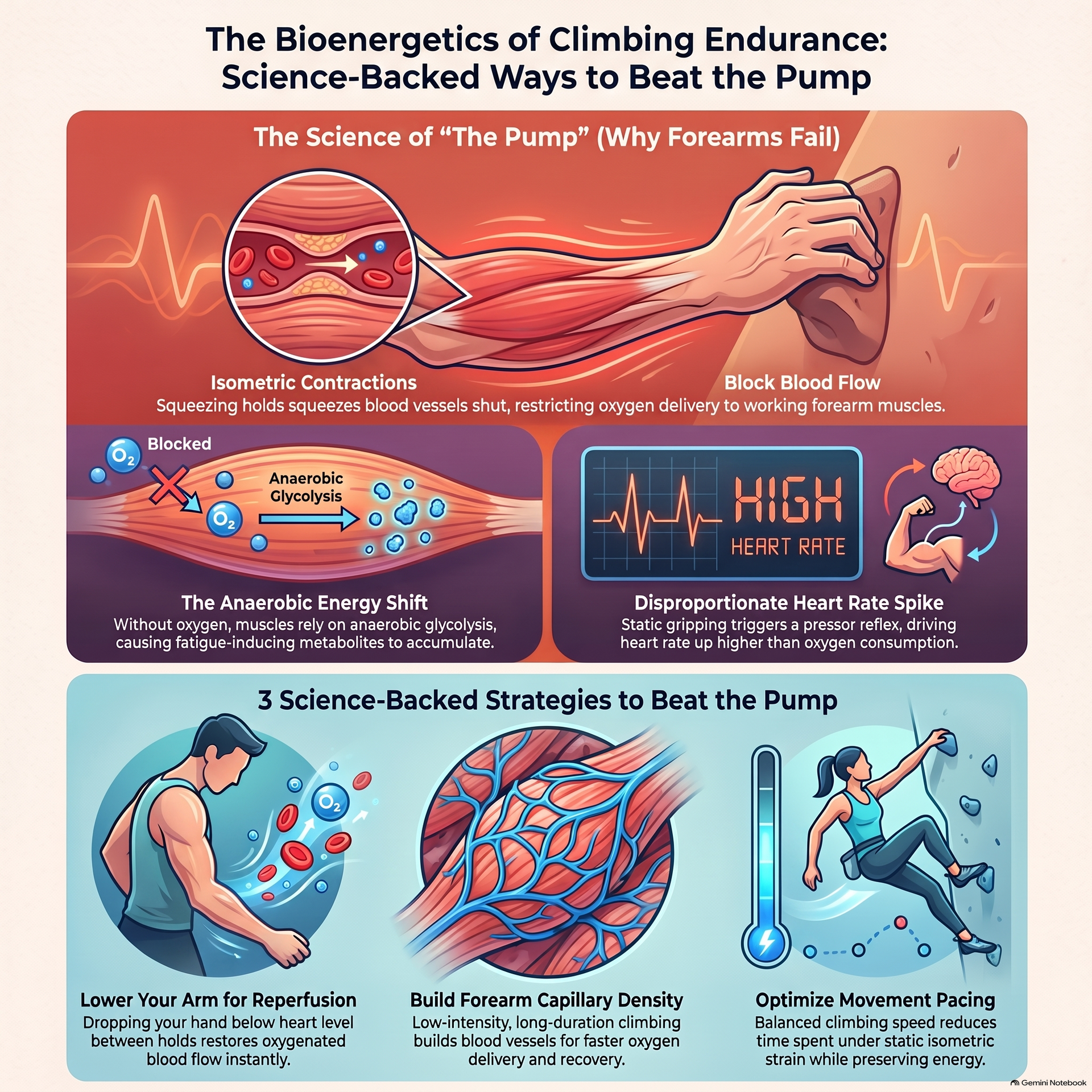
unguided climbers hit an immediate skill wall. Lacking formal instruction in precision footwork, hip rotation, and body geometry, they attempt to "muscle through" sequences. This causes rapid forearm flexor fatigue ("the pump"), deep frustration, and premature dropout.
2. Tissue Adaptation Mismatch and Overuse Injuries
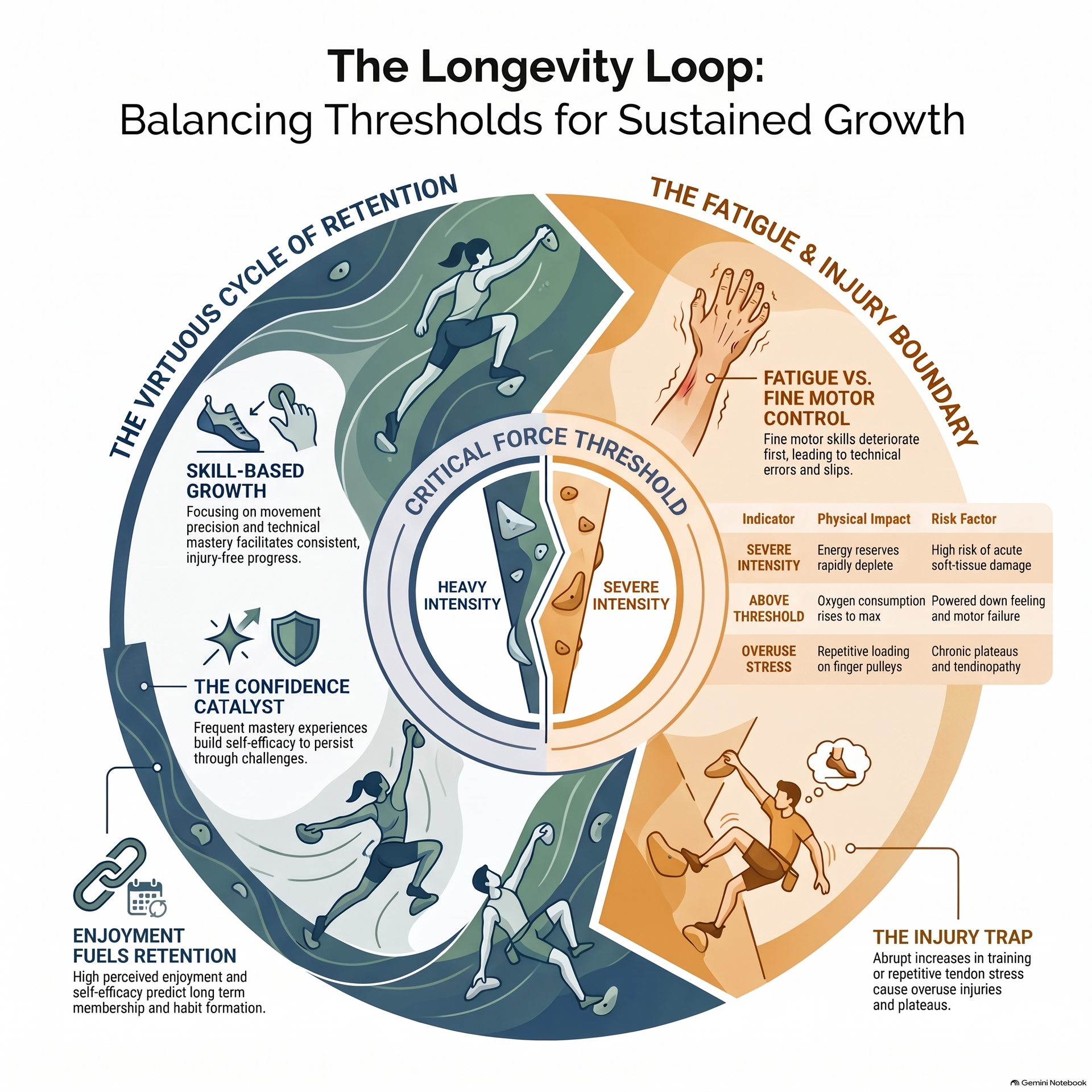
A critical risk factor for novice and intermediate climbers is the biological discrepancy between muscular growth and connective tissue remodeling. While skeletal muscle adapts quickly to increased exercise volume, finger flexor pulleys (A2/A4) and knee/shoulder ligaments adapt at a significantly slower pace.
Without structured movement instruction—such as open-hand gripping habits and proper lower-body engagement during heel hooks—climbers develop overuse injuries. Epidemiological research indicates that overuse pathology accounts for up to
93% of climbing-related physical issues, causing members to stop attending entirely.
3. The Isolation Paradox and Partner Deficits
Exercise adherence literature consistently demonstrates that
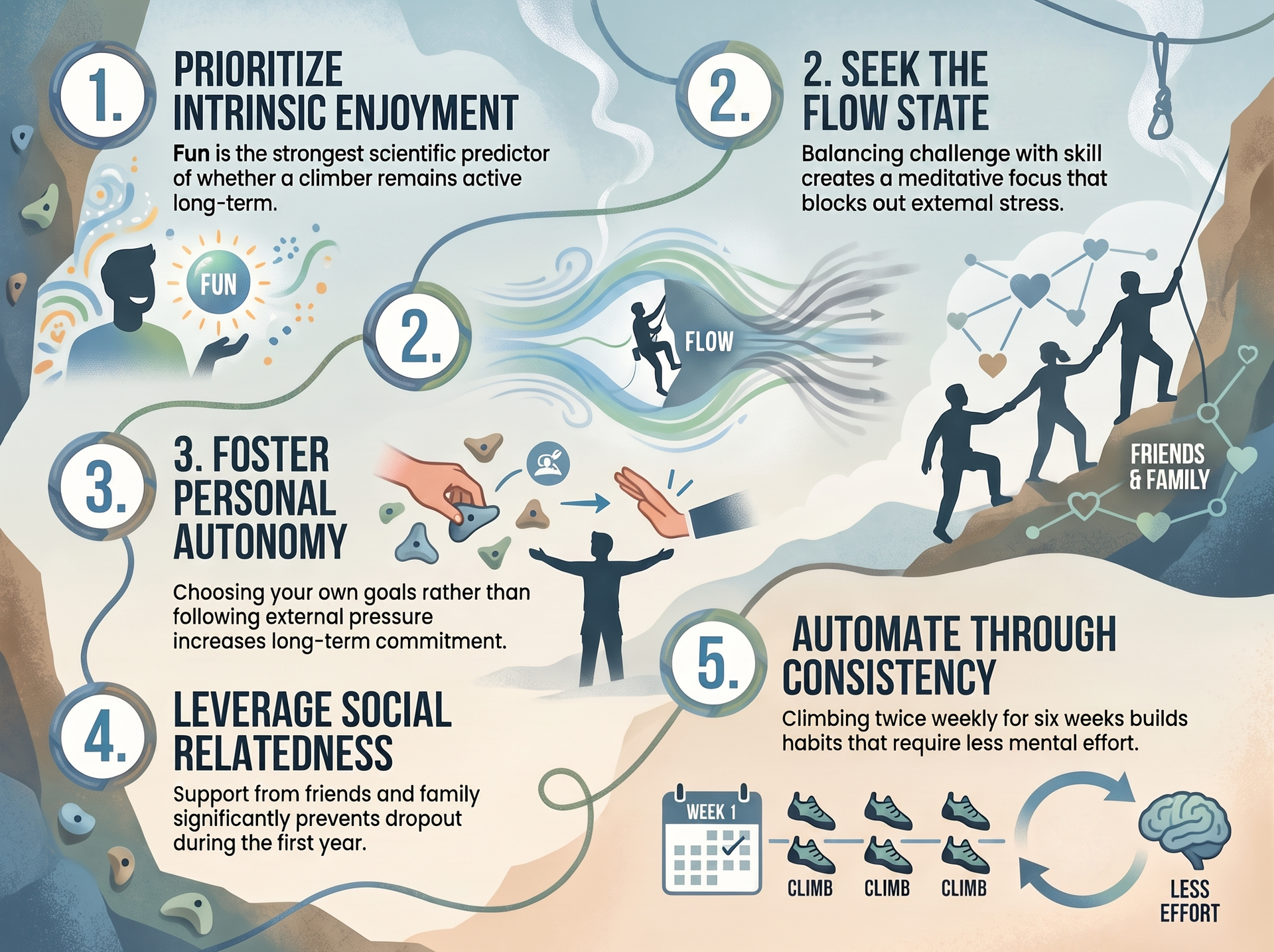
physical activity retention is heavily mediated by social connection and peer accountability. When a new member climbs solo without a regular belay partner or structured training cohort, their attendance frequency steadily declines.
Research indicates that
once a member’s visit frequency drops below 1 to 2 sessions per week, cancellation typically follows within 60 to 90 days.
4. The Flaw in Outdoor Grading Systems for Commercial Fitness
Outdoor consensus scales—such as the Yosemite Decimal System (YDS) or the V-Scale—were created as
utilitarian survival tools to communicate geological hazard, technical difficulty, and risk on natural rock formations.
Importing these outdoor grades directly onto indoor gym walls creates an environment where members can be left without other measures of their success beyond achieving higher grade.
When skill progression stalls, perceived competence collapses, destroying intrinsic motivation and
driving membership cancellation.
The Solution: Rethinking Onboarding and Climbing Longevity Through ClimbWell
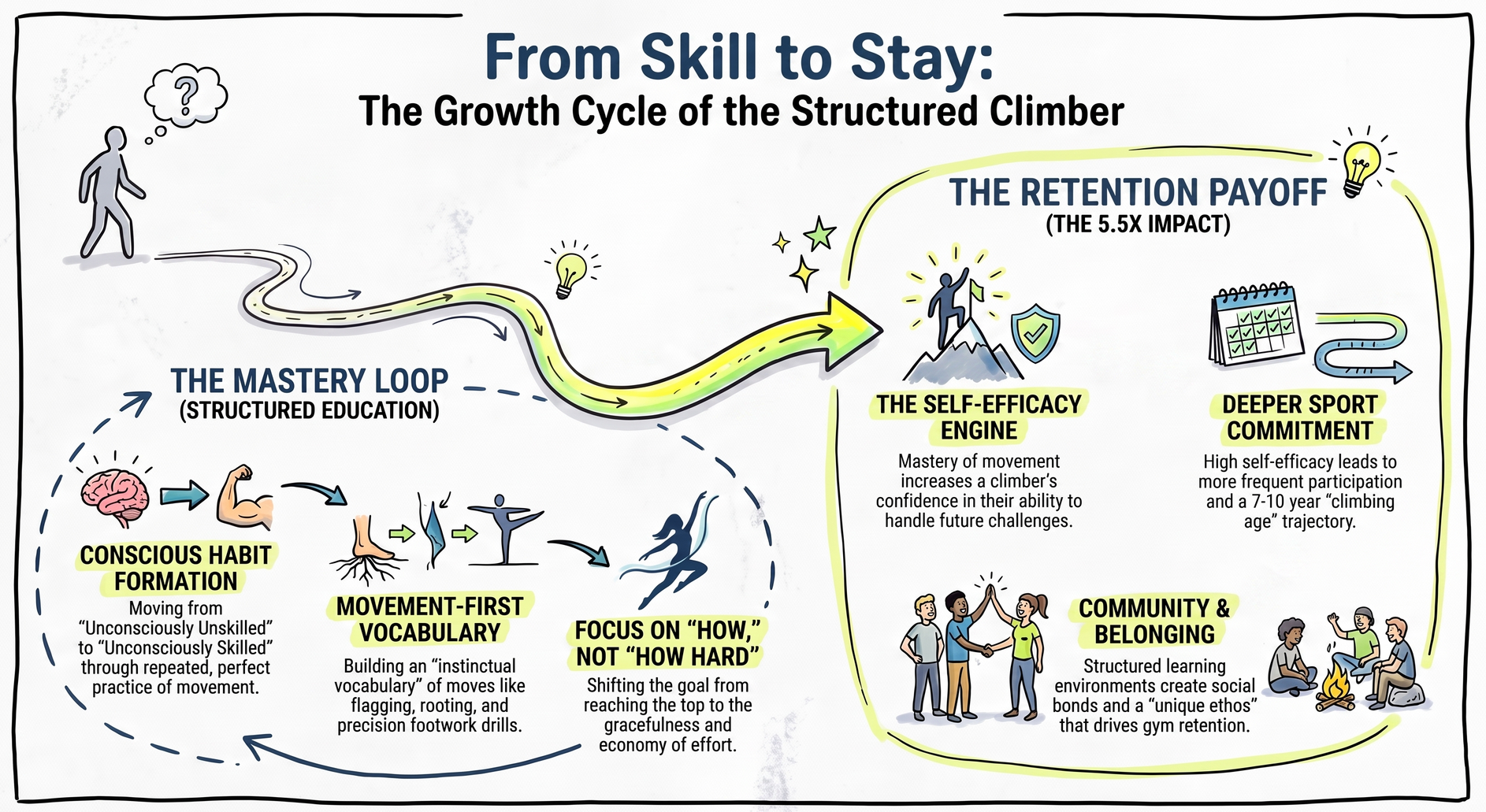
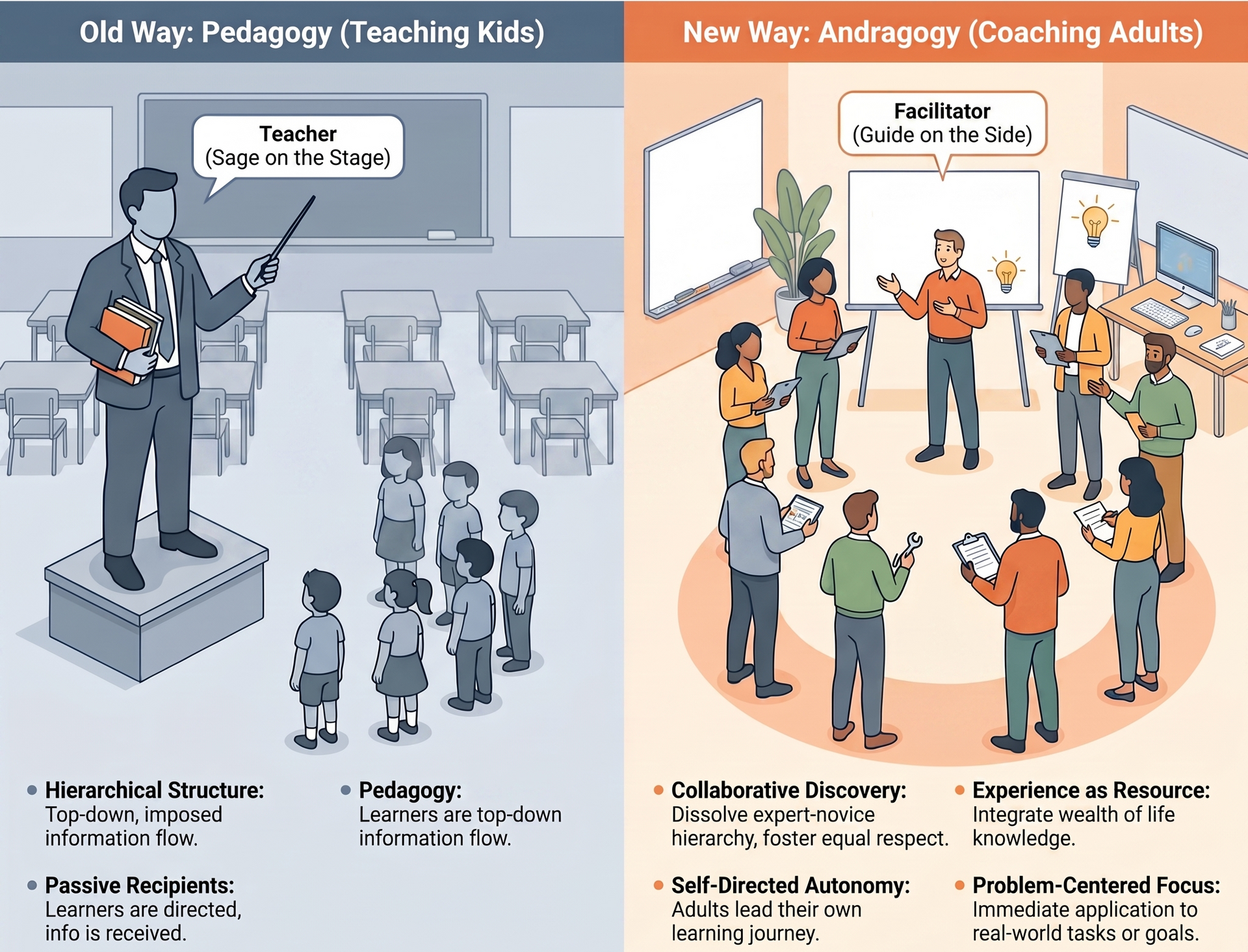
To address the member retention challenge, commercial facilities can broaden their approach to climbing achievement, mental and physical fitness, skills and technique development, maintenance of strength and balance, and partnership reliability through reframing their instructional and educational programs as
with ClimbWell.
At
ClimbWell Fitness, we provide an evidence-based, turnkey B2B movement program designed to bridge the gap between beginner intro classes and private coaching.
Ready to protect your recurring revenue and elevate your member experience?
Visit
climbwellfitness.com to request to review sample curriculum modules and schedule a consultation for your gym, facility, or community. Our work is intentionally designed about you and retaining your climbers.
Climb efficiently. Climb together. ClimbWell.
References
- Hussain, M., Javed, A., Khan, S. H., & Yasir, M. (2025). Pillars of Customer Retention in the Services Sector: Understanding the Role of Relationship Marketing, Customer Satisfaction, and Customer Loyalty. Journal of the Knowledge Economy, 16, 2047–2067.
- Jukes, L. M., Di Folco, S., Kearney, L., & Sawrikar, V. (2024). Barriers and Facilitators to Engaging Mothers and Fathers in Family-Based Interventions: A Qualitative Systematic Review. Child Psychiatry & Human Development, 55, 137–151.
- Morgan, P. J., Collins, C. E., Plotnikoff, R. C., et al. (2014). The 'Healthy Dads, Healthy Kids' community randomized controlled trial: A community-based healthy lifestyle program for fathers and their children. Preventive Medicine, 61, 90–99.
- Müller-Riemenschneider, F., Reinhold, T., Nocon, M., & Willich, S. N. (2008). Long-term effectiveness of interventions promoting physical activity: A systematic review. Preventive Medicine, 47, 354–368.
- The Decision Lab. (2026). Fostering Community Participation in Physical Activity: Behavioral Science Perspectives.
- Gremeaux, V., Gayda, M., Lepers, R., et al. (2012). Exercise and longevity. Maturitas, 73, 312–317.
- Hulteen, R. M., Morgan, P. J., Barnett, L. M., Stodden, D. F., & Lubans, D. R. (2018). Development of Foundational Movement Skills: A Conceptual Model for Physical Activity Across the Lifespan. Sports Medicine, 48, 1533–1540.