Stop Coaching Adults Like Kids: Applying Andragogy to Build a High-Retention Adult Academy
Applying Andragogy to Build a High-Retention Adult Academy
The commercial climbing gym industry is undergoing a massive structural shift. According to the 2026 Indoor Climber Survey conducted by the Climbing Wall Association (CWA) across more than 5,000 climbers in the U.S. and Canada, the overall climber demographic has significantly matured over the last seven years.
While the industry's historical growth was heavily driven by college students and competitive youth circuits, today's average climber is older and vastly more affluent. For gym operators, this shift represents a unique business opportunity. The data reveals that we are now serving a population that is "more financially stable, more time-constrained, and more deliberate about how they spend their discretionary hours". To retain these high-value, high-frequency members, gyms must completely rethink their educational business model.
Adults do not learn the way children do. To keep this demographic engaged, reduce their injury risk, and increase their opportunity for climbing longevity, operators must abandon traditional, top-down pedagogical coaching and instead apply andragogy—the specialized science of adult learning.
The Modern Adult Climber Demands "Predictable Experiences"
The days of the rugged, low-budget, subcultural climbing gym are rapidly fading. The CWA’s 2026 data shows a "clear broadening of the age distribution" with strong increases in climbers aged 35–54, paired with a significant rise in household incomes well above $150,000 and $200,000.
Because these mature, affluent professionals are highly time-constrained, their consumer expectations are exceptionally disciplined. For this demographic, high-value structural parameters such as:
"cleanliness, crowd management, predictable experiences, and flexible membership options frequently matter more than novelty amenities".
Furthermore, these climbers are highly committed; nearly three-quarters of CWA respondents now climb twice a week or more. If a gym fails to provide a highly organized, safe, and efficient environment during their limited free time, these members will quickly take their discretionary spending elsewhere (see also: The factors affecting adherence to physical activity in fitness facility settings: a narrative review).
Reconsider the Unused Gadgets: Focus on Structured Education
In an effort to appeal to tech-savvy adults, many gym managers have spent tens of thousands of dollars installing niche training boards, rotating Treadwalls, or complex spray walls. However, the data indicates that these capital investments may largely be missing the mark when they lack proper integration.
In the 2026 climber survey, members explicitly highlighted "underused training boards and fitness equipment that displace climbing terrain" as the primary features they would get rid of at their local gyms. Specialty fitness gadgets see highly uneven, low-yield use because climbers report that they are "unavailable, unnecessary, or poorly integrated" into their routines.
The business lesson for operators is clear:
"high-use, low-friction infrastructure outperforms niche equipment that lacks programming or education".
Instead of buying more unprogrammed boards, gyms must invest in "coaching, training communities, and more programming" to teach adults how to use the equipment they already have.
The Core of Andragogy: The Facilitator vs. The Sage
When we teach children, we often rely on pedagogy, a model where the instructor acts as the absolute authority delivering top-down, direct commands. For adults, this dynamic is counterproductive. Andragogy is defined as a science that "focuses on the learning process and the learner’s internalized needs rather than the teaching process and the teacher’s outcomes".
According to the pioneer of adult learning theory, Dr. Malcolm Knowles, adults are internally motivated and self-directed, and they will actively "resist learning when they feel others are imposing information, ideas, or actions on them". Furthermore, adults bring a rich lifetime of personal experiences, occupational skills, and established identities to the gym floor, which must be respected and used as a mutual resource.
To build a high-retention Adult Academy, your coaches/instructors must dissolve the traditional hierarchy of "expert over novice" into a:
"collaborative and democratic undertaking".
Your instructors must transition from being "sages-on-the-stage" to acting as "proactive mediators and facilitators of learning" who actively value and integrate the prior knowledge of their participants.
Actionable Strategies to Implement Adult Learning Science
To turn these scientific principles into gym revenue and membership retention, operators should structure their adult programs around three core evidence-based strategies:
1. Deliver "Challenge by Choice" via Autonomy-Supportive Coaching
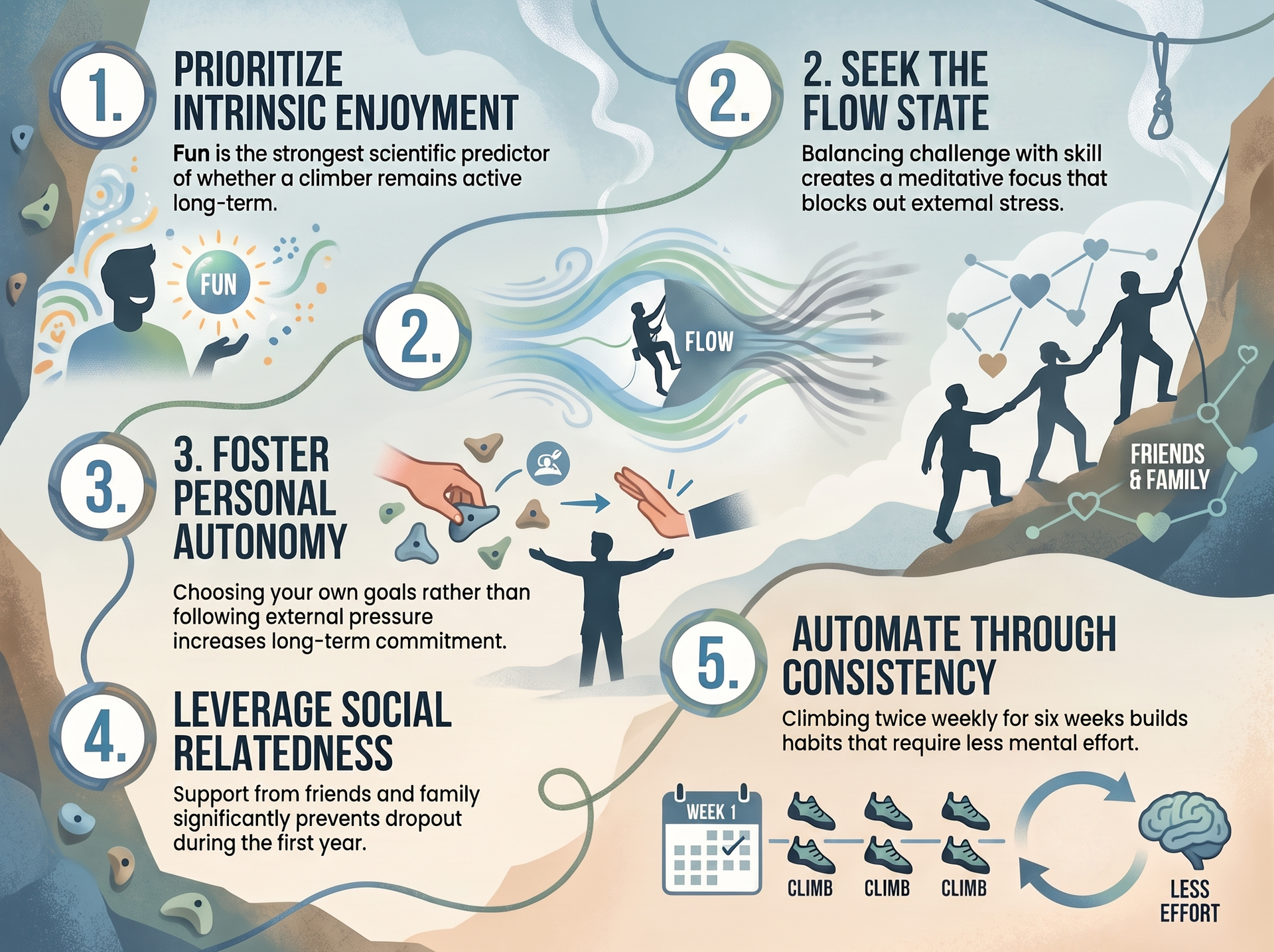
According to research on intrinsic motivation in sport, adults naturally thrive and persist in environments that satisfy their basic psychological needs for autonomy (feeling in control), relatedness (feeling connected to others), and competence (feeling capable).
Rather than prescribing rigid, mandatory workout regimens—which crowd out intrinsic motivation—coaches should utilize an autonomy-supportive style.
This involves explaining the "why" behind every movement pattern, offering a menu of acceptable exercise alternatives (such as selecting between dynamic heel hooking or static stemming), and letting the adult climber take active ownership of their training progression.
2. Reduce Training Anxiety Through Scaffolding
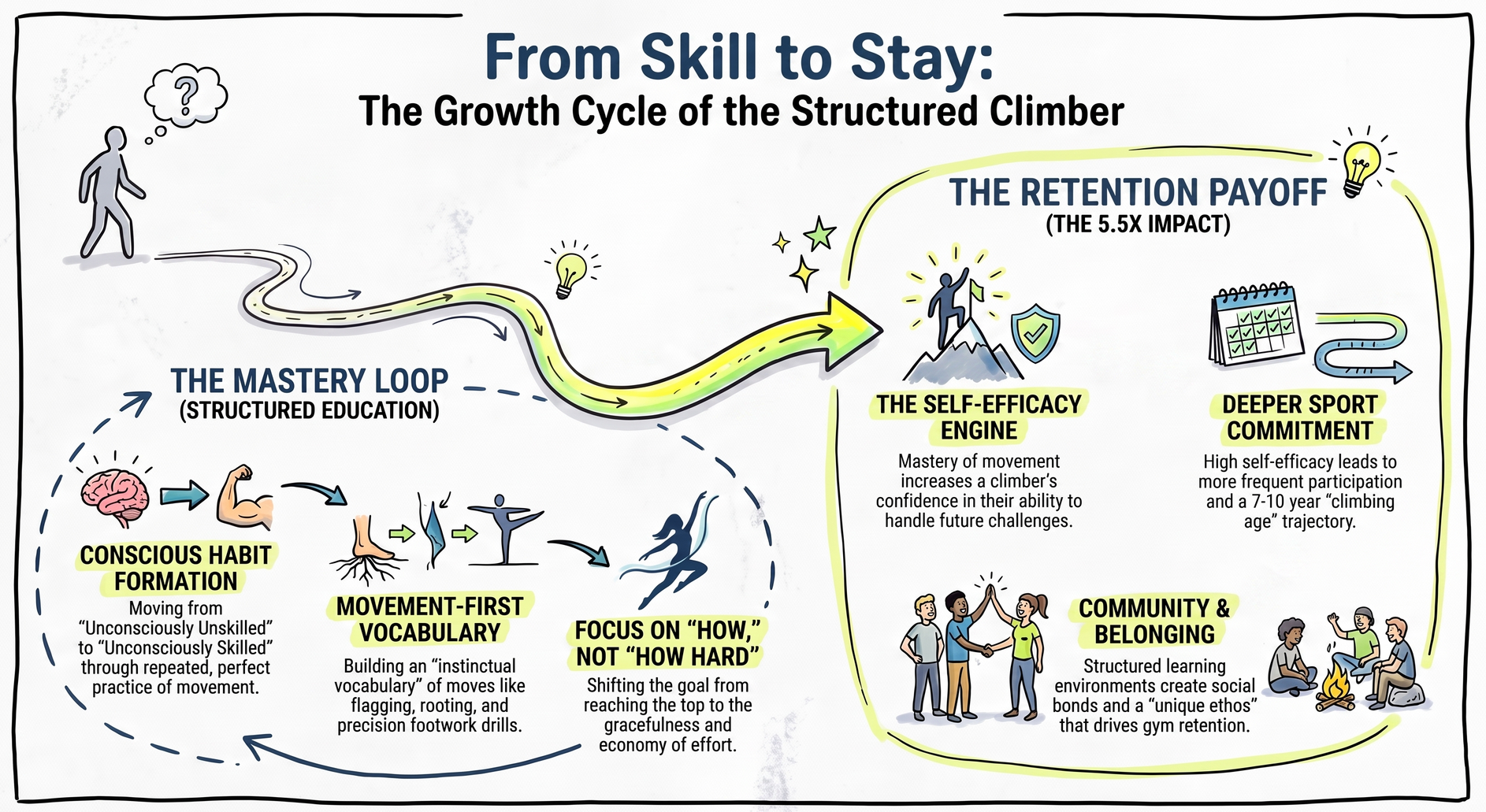
Many returning adults face significant anxiety and a lack of self-confidence when introduced to modern climbing techniques, vertical heights, or complex training systems. To combat this, adult programs must utilize scaffolding—the practice of:
"breaking down complicated tasks or skills into small components that can be completed one at a time".
By starting with movements that participants are highly likely to successfully execute and progressively layering complexity, coaches/instructors can help climbers feel comfortable to tackle new and challenging activities without feeling overwhelmed or defeated.
3. Drive Habit Formation with Gamified, Collaborative Play
Adults are highly goal-oriented and practical; they want to see exactly how their time on the wall translates to functional capacity. Adults, however, often struggle to maintain consistency with tedious technique drills or non-graded practice. To solve this, researchers advocate integrating game design principles into adult curriculums.
By converting repetitive skills practice into collaborative, gamified "quests" (such as our "Silent Feet" bell challenge or partner-based token hunts), you can:
foster a deep "sense of comradeship between students".
Randomized controlled trials of health programs specifically designed for time-constrained parents demonstrate that integrating gamified physical play and cooperative movement tasks achieves an exceptional 75% to 86% participant retention rate over multi-month interventions, with up to 79% of parents expressing a strong, self-directed intention to continue the activities long-term.
The Bottom Line for Gym Operators
The modern commercial climbing gym can no longer operate solely as an indoor playground for kids or a private training ground for elite athletes. By aligning your facility's design and programming with the CWA’s demographic realities and the proven science of andragogy, you may unlock an exceptionally profitable, loyal, and highly resilient membership base.
Redesigning your gym's culture to treat adults as active, self-directed collaborators on the wall supports them in:
staying healthy, building deep community connections, and remaining committed to your facility for decades to come.
References
- CWA Blog. What seven years of climber data tell us about where indoor climbing is headed. Climbing Wall Association. April 8, 2026.
- Mishkind A. Adult education: what makes teaching effective? California Adult Literacy Professional Development Project (CALPRO). July 2016.
- McCall RC, Padron K, Andrews C. Evidence-based instructional strategies for adult learners: a review of the literature. Codex: Journal of the Louisiana Chapter of the ACRL. 2018;4(4):29-47.
- Knowles MS, Holton EF, Swanson RA. The Adult Learner: The Definitive Classic in Adult Education and Human Resource Development. 7th ed. New York, NY: Routledge; 2012.
- U.S. Department of Education. Promoting teacher effectiveness: adult education teacher competencies. American Institutes for Research. 2015.
- The Decision Lab. Fostering community participation in physical activity. The Decision Lab. 2026.
- Mora A, Planas E, Arnedo-Moreno J. Designing game-like activities to engage adult learners in higher education. Open University of Catalonia. 2016.
- Clark M, Sutton BG, Lucett S. NASM Essentials of Personal Fitness Training. 6th ed. Boston, MA: Jones & Bartlett Learning; 2017.
- Mountain Training. Rock Climbing Candidate Instructor Handbook. Capel Curig, UK: Mountain Training; 2025.
- Mountain Training. Rock Climbing Development Instructor: Guidance for Trainers and Instructors. Capel Curig, UK: Mountain Training; 2025.
- Manninen M, Campbell S. The effect of the sport education model on basic needs intrinsic motivation and prosocial attitudes. European Physical Education Review. 2022;28(1):78-95.
- Madsen A, Pezzullo L, Nixon RM, Vincent KR, Vincent HK. Current sex and age patterns of rock climbing-related injuries treated in emergency departments. Frontiers in Sports and Active Living. 2025;7:1555169.