Climbing for Mental Clarity: How Wall Time Cuts Stress Hormones and Sharpens Cognitive Speed
Discover how indoor rock climbing reduces cortisol, boosts prefrontal cortex executive function, and sharpens cognitive processing speed based on clinical exercise science trials

For decades, traditional cardiovascular exercise—like jogging on a treadmill or riding a stationary bicycle—has been the gold standard for blowing off steam after a chaotic workday. But if you’ve ever zoned out on an elliptical while staring at a TV screen, you know that linear exercise doesn't always quiet a racing mind.
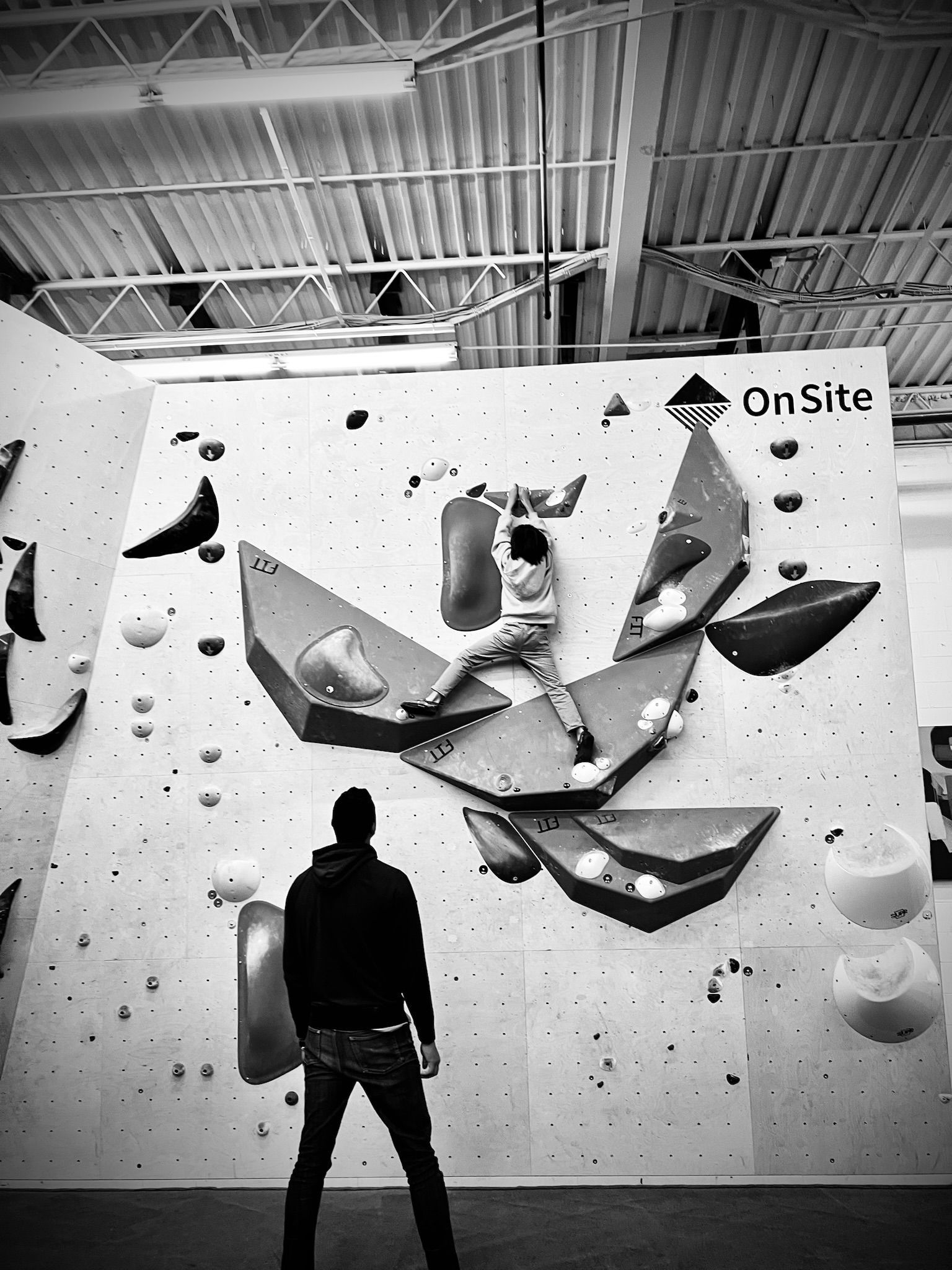
Enter indoor rock climbing. Far from being just a full-body workout, scaling a vertical wall acts as a dynamic mental reset button. Unlike routine cardio, climbing forces you to solve a three-dimensional physical puzzle in real-time, suspended meters above the floor.
Recent clinical exercise science demonstrates that this unique combination of physical exertion, spatial problem-solving, and emotional control dramatically cuts systemic stress hormones while speeding up cognitive processing time.
Here is how trading the treadmill for the climbing wall reshapes your brain chemistry and sharpens your mental edge.
The "Full-Body Chess Match": What Happens in Your Brain When You Climb?
To understand why climbing feels so mentally different from other sports, it helps to take a look under the hood of the central nervous system.
When you run on a flat track, your movement pattern is mostly repetitive and automated. Rock climbing, by contrast, presents an unfamiliar visual and physical puzzle every single turn—a process climbers call "route reading". You cannot zone out; you must stay completely present.
This is paragraph text. Click it or hit the Manage Text button to change the font, color, size, format, and more. To set up site-wide paragraph and title styles, go to Site Theme.

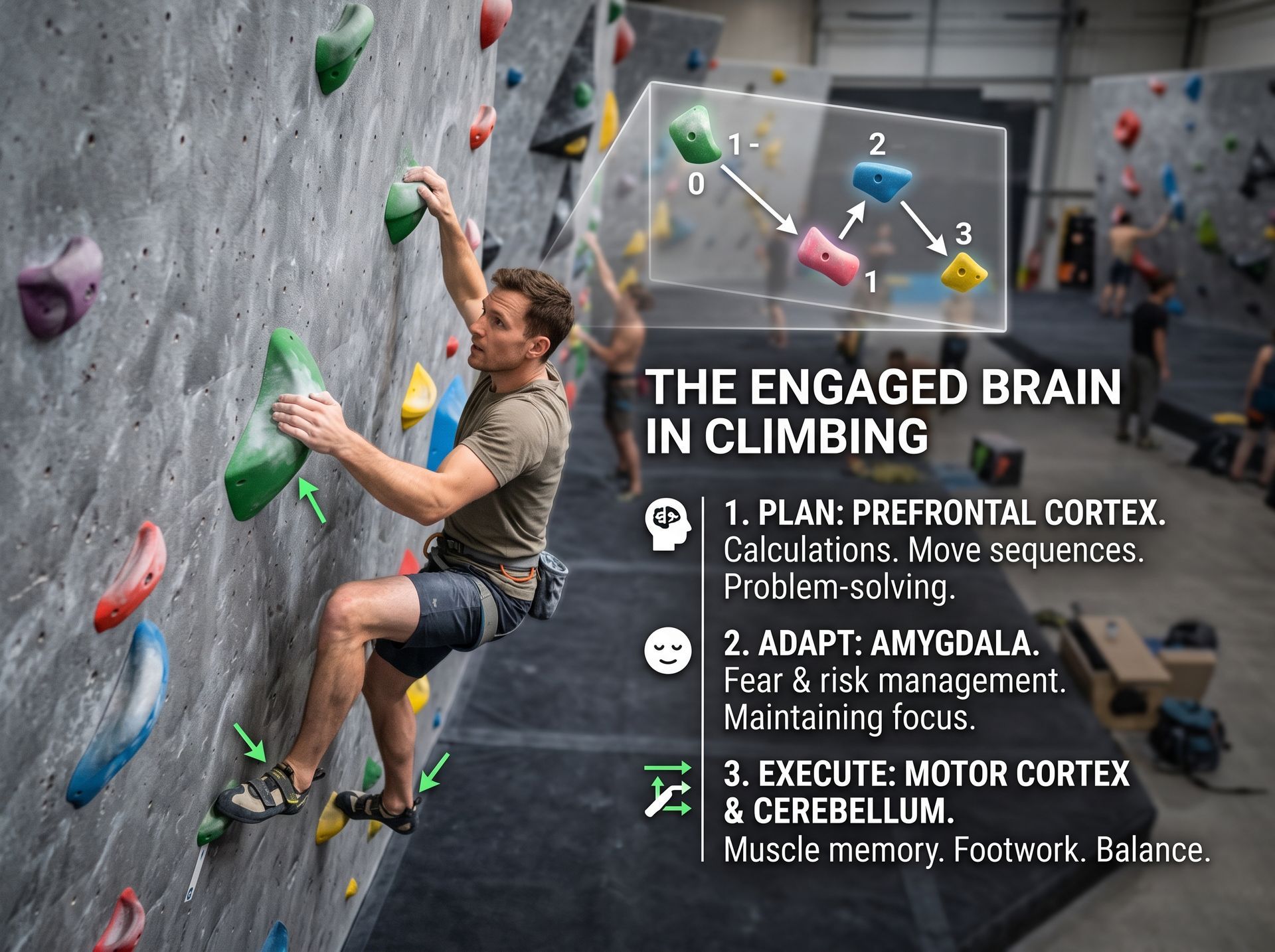
To negotiate a route, several distinct brain centers must work in harmony:
- The Prefrontal Cortex (Your "Executive Director"): Handles active decision-making, working memory, and spatial planning as you figure out where to place your hands and feet.
- The Amygdala (Your "Emotional Alarm"): Processes fear and perceived height, requiring you to actively self-regulate your nervous system so you don't freeze up.
- The Motor Cortex & Cerebellum (Your "Movement Navigators"): Fine-tune balance, muscle recruitment, and physical coordination.
Because climbing forces these subcortical emotional structures and high-level cognitive centers to communicate continuously, it creates an immersive state of focus. External worries, work deadlines, and daily stress are pushed aside because your brain is entirely occupied by the hold directly in front of you.
Slashing Stress: The Bio-Proof Behind Climbing’s Cortisol Drop
We often talk about "feeling less stressed" after a workout, but exercise scientists can measure stress objectively through salivary cortisol.
Cortisol is the body’s primary stress hormone, released by the adrenal glands. While acute spikes in cortisol help mobilize energy during short bursts of danger, chronically elevated cortisol impairs memory, disrupts sleep, and degrades cognitive health.
In a trial conducted by researchers at Northern Michigan University, exercise scientist Vanessa Steigauf evaluated how an acute session of indoor climbing impacts cortisol levels in healthy adults. Participants performed a structured session on an automated rotating climbing wall (a Treadwall) set to a comfortable, moderate intensity. They climbed in 2-minute intervals paired with 2-minute rest periods over 40 minutes, closely mimicking the natural rhythm of climbing and belaying with a partner.
The bio-chemical results were striking: participants experienced a 60.9% drop in circulating cortisol post-climb, demonstrating significant nervous system relaxation and parasympathetic recovery. Statistical modeling confirmed this dramatic decline over time.
Far from overloading the nervous system, moderate indoor climbing helps down-regulate stress markers.
Mental Supercharge: How Wall Time Shaves Milliseconds Off Reaction Speed
Reducing stress is only half the equation; the Steigauf study also examined whether this neuroendocrine shift translated into sharper mental processing.
To test this, researchers administered the Stroop Color and Word Test before and after the climbing session. The Stroop task is a classic neuropsychological benchmark that measures executive function, mental processing speed, and response inhibition by asking participants to identify word colors when the text spells a conflicting color name (e.g., the word "RED" printed in blue ink).
The trial revealed two major findings:
- Faster Reaction Times: Following the climbing session, participants’ mental processing speed accelerated significantly, shaving 53.9 milliseconds off their average reaction time (dropping from 697 ms down to 643 ms).
- Uncompromising Accuracy: Despite processing information faster, participants maintained an impressive 97% decision accuracy rate (0.97 post-climb vs. 0.96 pre-climb).
In plain English: Climbing sharpens your mental reflexes without making you sloppy.
Researchers attribute this cognitive boost to increased cerebral blood flow, heightened prefrontal cortex oxygenation, and the release of key neurotransmitters like dopamine and norepinephrine, which wake up cortical circuits and prime the brain for active problem-solving.
Finding the Sweet Spot: Arousal, Fear, and the "Flow State"
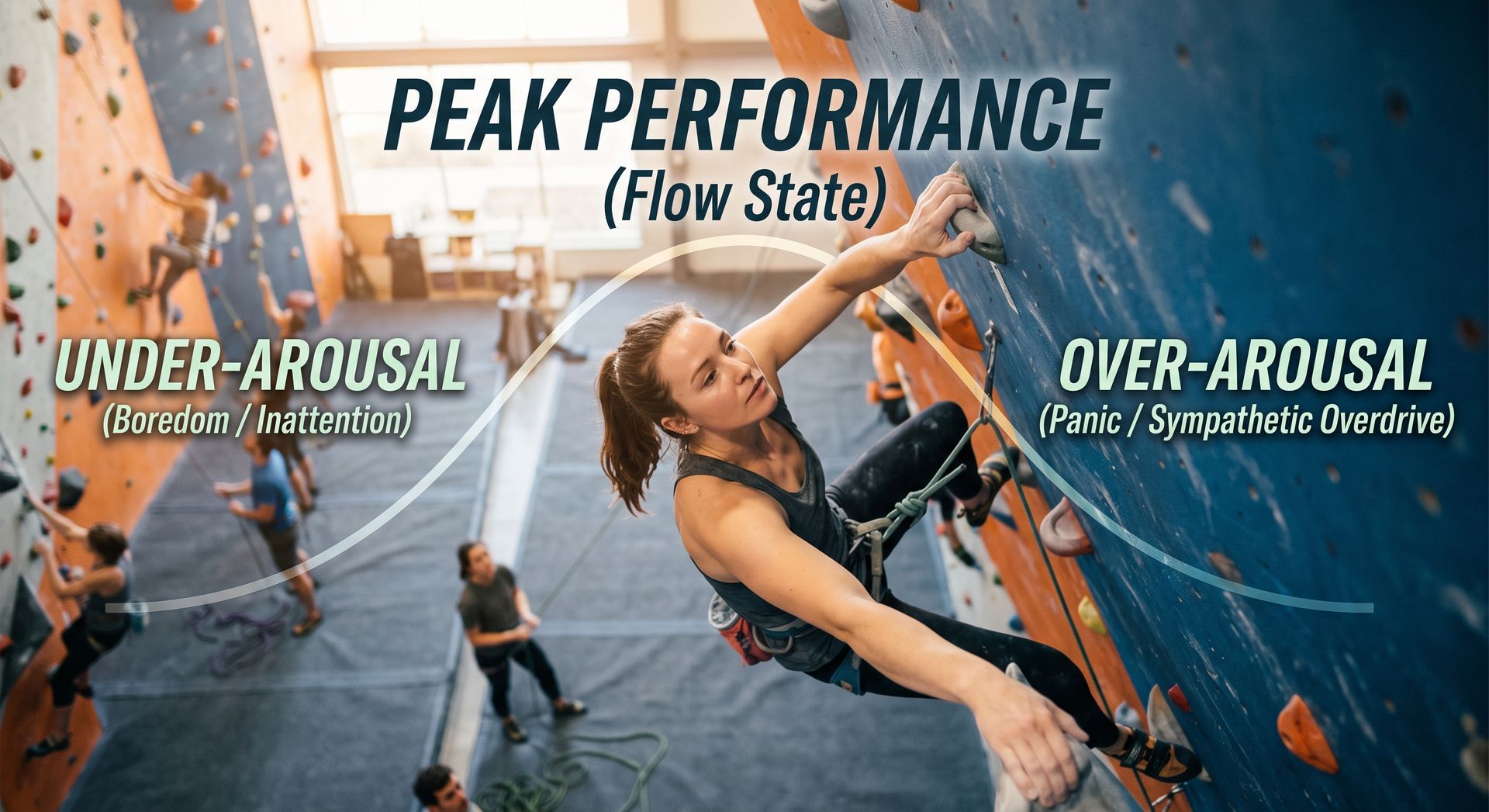
How does climbing achieve this mental balance? The answer lies in a classic psychological concept known as the Yerkes-Dodson Law.
This principle states that cognitive performance follows an inverted-U curve relative to physiological arousal:

- Too Little Arousal (Boredom): When an exercise is overly repetitive, your mind wanders, resulting in low engagement.
- Too Much Arousal (Panic): If you are overwhelmed by intense fear or exhaustion, your sympathetic nervous system ("fight-or-flight") goes into overdrive, causing cold sweats, rapid breathing, muscle tension, and mental freeze-ups.
- Moderate Arousal (The "Flow State"): Controlled physical risk and spatial problem-solving push your brain into a state of heightened alertness and effortless concentration.
When you step onto a climbing wall, your brain experiences a controlled surge of adrenaline and focus.
By learning to manage your breathing, analyze hold options, and stay calm under physical effort, you train your nervous system to stay balanced in high-arousal environments—a skill that translates directly into handling daily workplace stress.
From Gym Walls to Clinical Care: The Future of Climbing and Mental Engagement
The unique mental demands of climbing have led clinicians to explore its potential as a structured health intervention:
- Depression and Mood Regulation: Clinical trials examining indoor bouldering programs for adults with Major Depressive Disorder (MDD) found that climbing sessions significantly reduced negative affect and boosted coping emotions, outperforming passive relaxation techniques.
- Anxiety Relief: An 8-week sport climbing intervention significantly reduced both cognitive and somatic anxiety in previously sedentary adults.
- Clinical & Neurological Care: Therapeutic climbing protocols are actively being studied as targeted interventions for neurological conditions—such as Multiple Sclerosis (to improve motor coordination and muscle strength), Autism (enhancing spatial reasoning and executive control), and Depression/Anxiety—while exercise scientists highlight its potential to protect cognitive reserve during aging.
The Takeaway for Readers
You don't need to scale high-altitude mountain peaks to reap the mental rewards of climbing. Spending 30 to 45 minutes at a local indoor climbing gym offers a scientifically backed way to clear mental fatigue, lower cortisol, and boost brain speed.
The next time you feel overwhelmed by a long week, consider skipping the treadmill and heading for the climbing wall—your prefrontal cortex will thank you.
Bibliography
- Steigauf V. The Effect of an Acute Bout of Rock Climbing on Cognitive Functioning and Cortisol Levels. Master's thesis. Northern Michigan University; 2025.
- Chang YK, Labban JD, Gapin JI, Etnier JL. The effects of acute exercise on cognitive performance: A meta-analysis. Brain Res. 2012;1453:87-101. doi:10.1016/j.brainres.2012.02.068
- Basso JC, Suzuki WA. The effects of acute exercise on mood, cognition, neurophysiology, and neurochemical pathways: A review. Brain Plast. 2017;2(2):127-152. doi:10.3233/BPL-160040
- Callender NA, Hart PW, Ramchandani GM, et al. Cardiorespiratory demands of competitive rock climbing. Appl Physiol Nutr Metab. 2021;46(2):161-166. doi:10.1139/apnm-2020-0487
- Janot JM, Steffen JP, Porcari JP, Maher MA. Heart rate responses and perceived exertion for beginner and recreational sport climbers during indoor climbing. J Exerc Physiol Online. 2000;3(1):1-9.
- Kleinstäuber M, Reuter M, Doll N, Fallgatter AJ. Rock climbing and acute emotion regulation in patients with major depressive disorder in the context of a psychological inpatient treatment: A controlled pilot trial. Psychol Res Behav Manag. 2017;10:277-281. doi:10.2147/PRBM.S143830
- Aras D, Ewert A. The effects of eight weeks sport rock climbing training on anxiety. Acta Med Mediterr. 2016;32:223-230. doi:10.19193/0393-6384_2016_1_35